

Greetings artists, writers, creatives, and everyone in between! On the heels of my last post, I thought I’d lay out some of the most common art scams I’ve come across in my time doing business as an artist, working on websites, and things I’ve seen cross the desks of fellow creatives.
Why am I the mark?
I’m in a very particular position where I don’t have a huge following on most major social media sites, so to the outside world, it may seem that I am less of a professional illustrator, and more of an artist starting out. I find that because of this, scams that would not cross paths with larger more well known artists tend to filter down to me. Unfortunately for the scams/scammers, I am not an easy mark – they have no reason to know this, especially when they’re spraying their scams en masse to a lot of people. Still, it’s good for you to be aware that if you fall into this area of “appears to be an artist starting out” (you may even be one for real!) or have a low number of followers on social, it is very likely that these folks will target you. Be wary of everything that comes in through DMs or your email (especially when not from people you know), and note any red flags you may encounter. Let’s go into a few common scams.
Common Scam #1: Commission Scam
This is still very prevalent today. Usually it’s conducted over DMs in a place like Instagram or Facebook. The scammer will approach asking usually for you to draw their friend, family member, or dog – even if you draw dragons primarily, or something else. The goal is to get you to hand over your PayPal credentials (or some other payment system). Usually it goes like this:
- Commission request
- Talk of what they want
- They request your PayPal UN/email to “send you money”
- You get a sudden email looking to be from PayPal saying that the money they sent is locked up
- They trick you into clicking the link in the email and entering your account info there under the pretense you are “releasing the funds”
- They now have your login info.
This can also go another way:
- Commission request
- Talk of what they want
- They request your PayPal UN/email to “send you money”
- You get a sudden email looking to be from PayPal saying that the money they sent is locked up. The email states you must send money back to the sender to unlock these funds
- You send real, actual money back to them, scammer leaves with your $.
Red flags:
- AI generated profile picture and posts.
- New account.
- Person who DMed or emailed doesn’t follow you or any account you know, or only recently followed you. You have never seen them like or comment on any of your posts (and if they have, it has only happened recently)
- English-as-not-a-first-language signs like additional or errant punctuation, spaces where there shouldn’t be any, capital letters unexpectedly, poor grammar. Don’t discount someone entirely based on this alone – but compounded with other red flags you may feel safer to stay away.
- A commission request distinctly far and away from the type of work you usually do i.e. “my dad” or “my wife” and you only draw animals.
- Person gets pushy or agitated if you decline their commission.
- Will not give you their PayPal/email address so you can issue a PayPal invoice rather than having them send you money.
- Person who made contact claims to be an “apraxia patient” or similar which makes it only possible for them to conduct business via email.
Common Scam #2: Art Collector Scam
This one usually comes through over contact forms on websites. This still happens a lot today, because I just got one the other day! Here’s what it looks like:
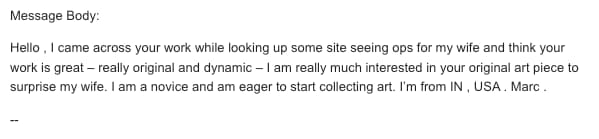
Somehow, this type of scam is always “a surprise” for a significant other. I’ve seen some variations of this, many of them where the “collector” will come flaunt a significant sum of money asking if it’s enough to buy anything from you. Don’t be blinded by the numbers – none of it is real and you can end up losing money yourself. Usually, the scammer here will conduct an “overpayment” scam where they send you a bogus check, you deposit it, while those funds are clearing with the bank you send a real check back and they abscond with your money.
Red flags:
- Markers for English-as-not-a-first-language.
- Text identical to other scams (Paste it into Google!)
- No mention of any particulars regarding your work; no mention of particular works, how they came to your site, etc.
- Insists on paying via check or another irregular payment method that allows for their scam to have the ability to work.
Common Scam #3: Theft
It’s less of a scam and more of an outright legal issue, but many artists struggle with their artworks being stolen and used without their permission for profit. You can see a lot of this happening through Alibaba and other online retailers, especially print on demand services. Unauthorized use for monetary gain is something you can take legal action against. One service I suggest to artists to use is Pixsy, which can help you monitor your works online and file against unauthorized replications and use.
You can also use HaveIBeenTrained to see if your works reside in the LAION 5B dataset that makes up the bulk of LLM visual training sets.
Common Scam #4: Impersonation
Bluesky is currently seeing an influx in impersonation scammers. Usually, this targets your fanbase rather than yourself. Scammers will create an account identical to your own but with a hardly noticeable difference in the username, and start sending out DMs asking for money, for commissions, or something else. Many artists claim to never know about these impersonation accounts until people they know let them know. There’s not a whole lot you can do about it currently on Bluesky, but here’s some steps you can take to mitigate this:
- Verify a dot com as your handle. For example, my username is aimeecozza.com, and since I am the owner of that website, another user could not be verified under my domain as me.
- After verifying your dot com, register a new account under the old username. Since once you vacate into the upper levels that is domain verification your username gets cast back into the pool, that means it’s up for grabs. Squat that before a scammer or impersonation account can. As of 1/3/25, Bluesky has now made it that you do not have to do this step if you verify a dot com, which is great news!
Common Scam #5: Copyright Infringement Claims
This one came through quickly one year en masse, but on occasion does rear its ugly head from time to time. I’ve seen it come through contact form submissions as well as blog comments. What happens is these scammers reach out to you claiming they are a photographer, artist, or other copyright holder and that you/your website is infringing on their copyright. They send along a link to a Drive or Dropbox and urge you to click it to see what content is theirs. In that link is malware, or a form that intends to phish you of personal information. Do not click Drive or Dropbox links from random people. Do not open attachments from people you don’t know.
Common Scam #6: NFTs
You’re probably well aware of this one at this point. People offering you to “mint” your works as NFTs, or asking you to mint them so they can buy them as NFTs. Usually conducted via comments or DMs, the goal of these scammers is to get you to use the NFT platform. Artists are responsible for footing the bill for the “minting” of NFTs, and your random “buyer” will disappear as soon as you mint on the NFT platform of their choice.
Common Scam #7: “Collaboration” and/or pay-to-play
This is sometimes less of a scam in the sense that it’s likely you may actually end up with something in the end, but I’m calling these types of things scams as they are intended to part you from your money, while not delivering fully on promises that are made to you.
“Collaborate” scams
You’ll often see these come through DMs on social media, as well as emails (usually email addresses associated with your social media accounts). Those who make contact will say they want to “collaborate” with you by having you make posts about them, having you pay for product, that sort of thing. This is really easy to see as many of these “collaborators” are asking you about jewelry, or lifestyle services, and as an artist you’re generally not needing the collaborate with anyone selling those things (unless you really wanted to), so they’re wildly off spec.
Pay-to-play scams
Also conducted via DMs on social media or via email addresses associated with your social media accounts, these types of scams ask you for money to be featured in posts on a social media account, an interview on a blog, or a “shoutout” via a newsletter. Many of the times, the contact person boasts a large following on social media – which, upon inspection, is made up of bots or bought followers. I warn artists that you should never have to pay someone to interview you. If a well-known internet blog, magazine, etc wants to write about you, they will. If anyone asks you to pay them for that, it’s not legitimate.
You should never have to pay for a shoutout on social media, either – however, many content sharing accounts do offer purchase plans for posting to their accounts (i.e. “DM us to be featured!”). Be wary, because these often can be costly and don’t have the desired effect.
Common Scam #8: Spec Work
For the uninitiated, “spec work”, or speculative work, is work done with the possibility of pay, but no guarantee of it.
Here are some examples:
- Enter highly specific artworks for a chance to win money or a prize.
- Enter highly specific artworks to be voted on to be determined whether or not you will receive money or a prize.
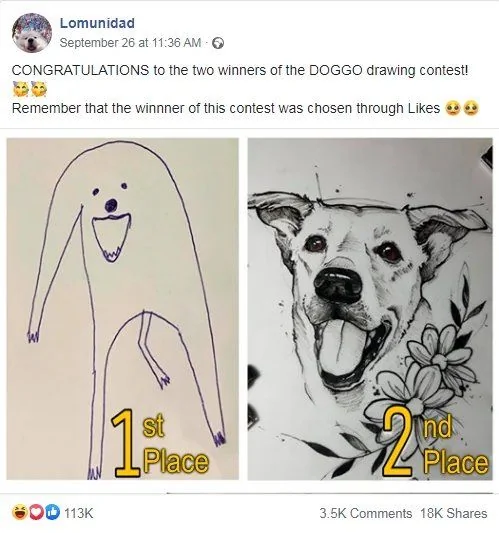
Spec work is a plague on creative fields. No other field would you have multiple people perform work, and then only decide to pay one of them for the outcome. Whether it’s your local elementary school running a “contest” for a logo or a large, well known brand name like Netflix asking you to submit fanarts (in exchange for all of your rights to your own artwork) for a chance to be featured on their something-or-other, no matter who is running it or what it’s for, if there’s no guarantee of payment but the carrot has been dangled that you can get paid if chosen, then it’s spec work.
This is to say that you can engage in spec work as you please, but many artists are disappointed with the outcomes of many spec work campaigns that are essentially just popularity contests. It allows stuff like this to happen, where, while hilarious, if the actual prize for a first place winner is monetary and the second place artist spent a lot of time and effort making their piece, it can be extremely demotivating:
Projects in which are made for fun/the love of something should say that outright, for example I ran a fan tarot card project for Coheed & Cambria. While I did end up able to pay each artist with the money raised during the pre-order period, the expectation was set there would be zero pay for anyone and we were all pleasantly surprised to spread around a little bit of money to those involved. Many zines are run just like this, and to be fair to contributors they will be outright about this factor. If we make it to profit status, everyone will get paid, but don’t hold your breath.
How to prevent being scammed
It’s hard to catch everything, especially if you’re new to the art world and excited to do business with people! However, be wary of red flags, and trust yourself to feel when something seems “off.” Ask your art friends, or cast out to a wider audience on Reddit, Bsky, Mastodon, or elsewhere to get a feeling if other people think it sounds scammy. Here’s a few key takeaways you can use to protect yourself:
- Conduct sales and business through legitimate channels like a shop or somewhere like Vgen.
- Protect yourself with signed contract(s) detailing the terms and conditions, payment, and more, especially if the client is working with you for the very first time.
- Never pay up front for anything – commissions, interviews, posts, any of it.
- If someone gets aggressive with you, walk away.
- Never click unclear or vague links from email addresses/people you don’t know. Check legitimate looking emails making strange requests very closely.
Be wary of requests for help from people you do know (“I need to use your phone number to break into my IG/FB account!” is still a common one after someone you know has been hacked).
I hope these help you stay safe into 2025 and keep your art business moving along! Let me know if I missed any common scams or details. I’ll be happy to append!